Introduction: The Eyes and Ears of the Vehicle Remember when driving relied entirely on mechanical feedback—a physical cable spinning your speedometer needle or a vacuum line adjusting your ignition timing?
Today, those mechanical links have vanished. Modern vehicles are essentially software-defined data hubs on wheels. At the very edge of this digital architecture sit automotive sensors. Without them, advanced driver-assistance systems (ADAS), electric powertrains, and even basic engine management would completely grind to a halt.
If you are tracking the evolution of Software-Defined Vehicles (SDVs) or building core automotive knowledge, understanding sensors is where it all begins. Let's look under the hood at how they work, how they classify data, and why they matter.
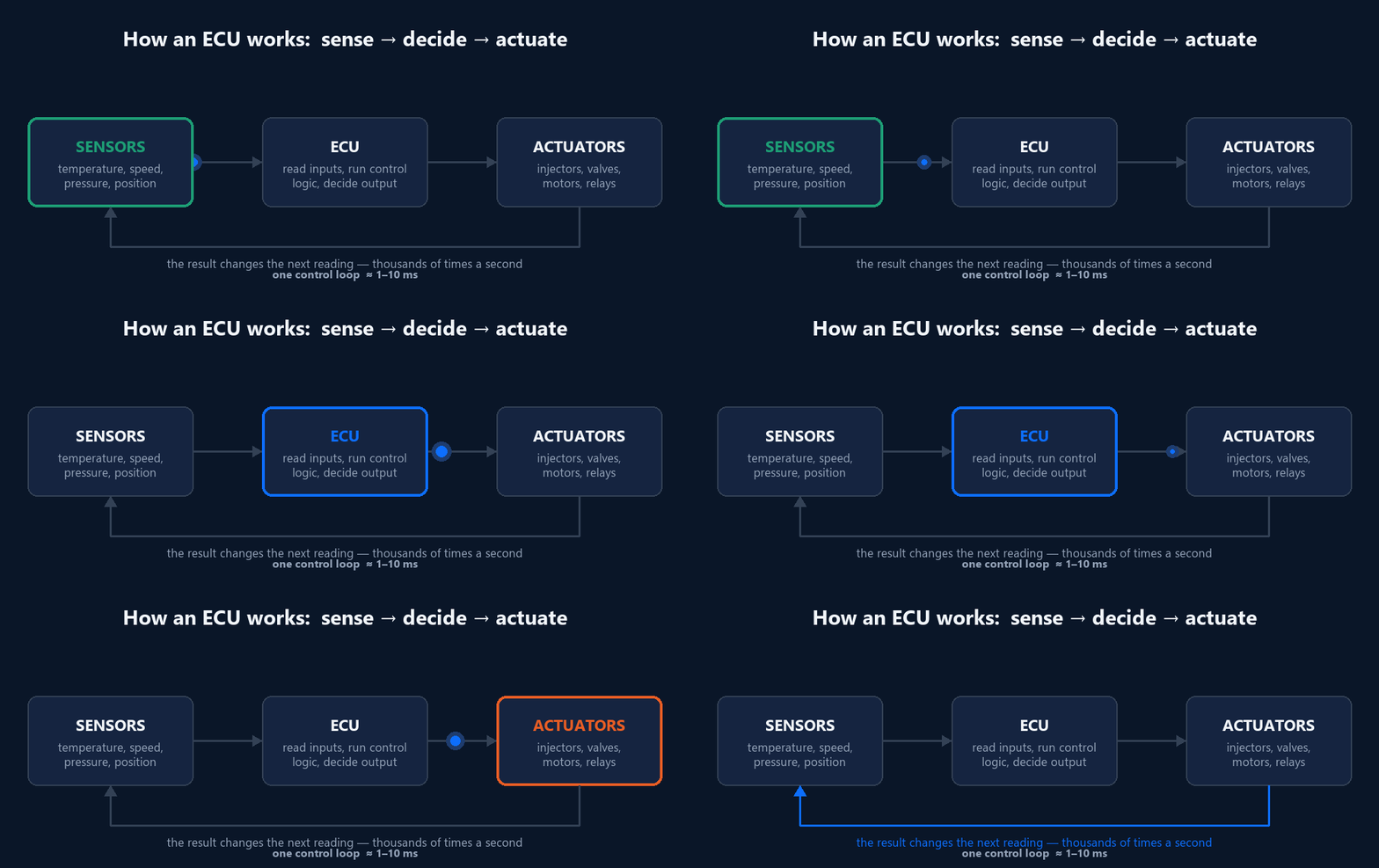
Core Know-How: How an Automotive Sensor Works At its fundamental hardware level, an automotive sensor performs one critical job: transduction. It takes a physical phenomenon (like heat, pressure, rotation, or light) and converts it into an electrical signal (voltage or current) that an Electronic Control Unit (ECU) can interpret.
Physical Phenomenon (Heat/Pressure/Motion)
▼
Sensor Transducer / Element ] ──> [ Signal Conditioning (Amplification/Filtering)
▼
Analog/Digital Conversion (ADC) ] ──> [ Transmitted over CAN/LIN Bus to ECU
The Anatomy of a Sensor Node The Sensing Element: Directly interacts with the environment (e.g., a piezoresistive diaphragm sensing manifold pressure).
Signal Conditioning Circuitry: Amplifies weak electrical signals, filters out electrical noise (crucial in harsh automotive environments), and sometimes converts analog signals to digital data using an Analog-to-Digital Converter (ADC).
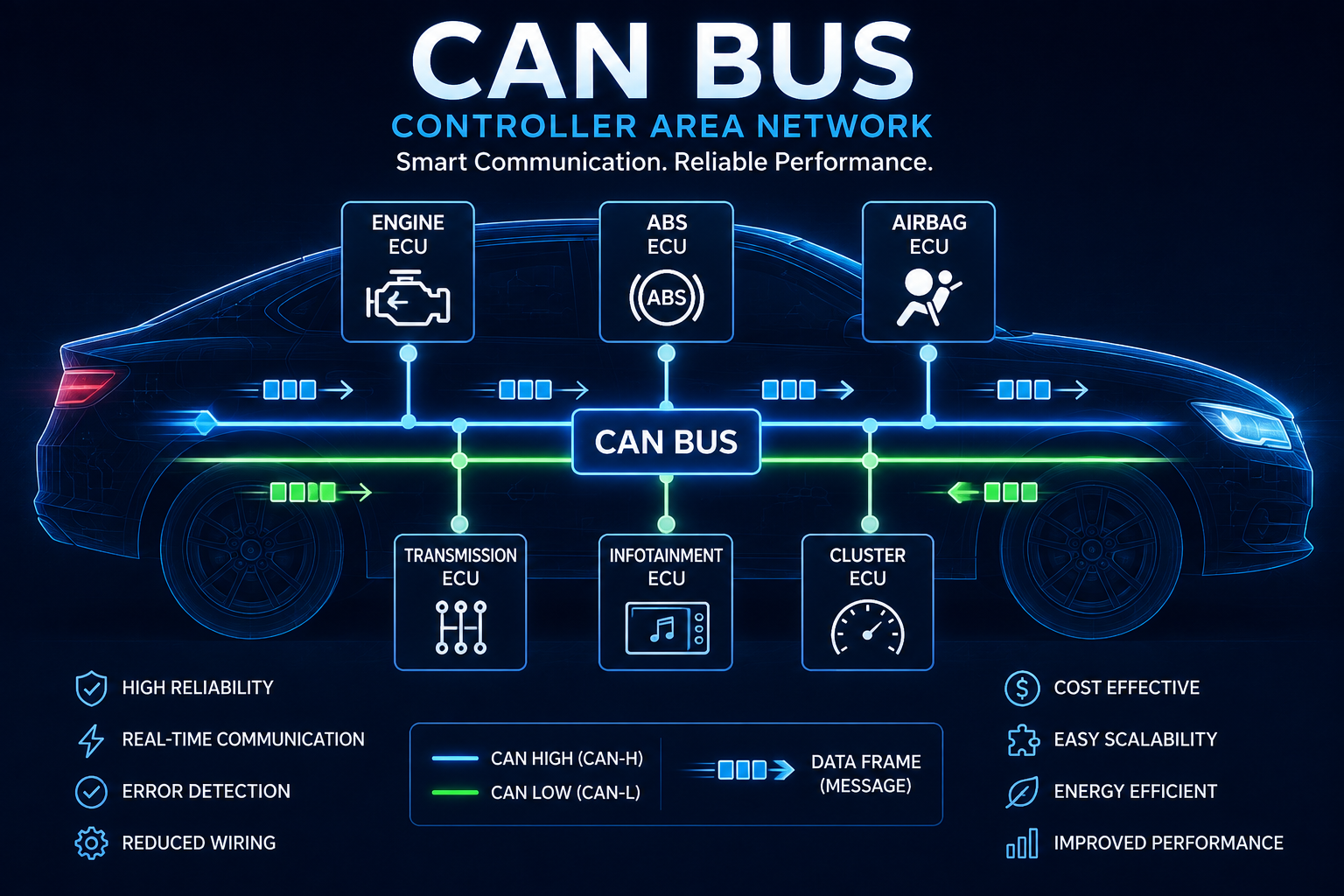
Communication Interface: Transmits the digitized data to domain controllers or microcontrollers over robust vehicle networks like CAN (Controller Area Network) or LIN (Local Interconnect Network) buses.
Classification of Automotive Sensors: To make sense of the hundreds of sensors packed into a modern chassis, automotive engineers categorize them by function and target measurement.A. Powertrain & Engine Management SensorsThese monitor the internal combustion or electric propulsion systems to optimize fuel efficiency, emissions, and torque.Mass Air Flow (MAF) Sensor: Measures the volume and density of air entering the engine so the ECU can inject the precise amount of fuel.Camshaft/Crankshaft Position Sensors: Uses magnetic or Hall-effect principles to track engine RPM and piston position, ensuring exact spark and fuel injection timing.Oxygen ($O_2$) Sensor: Analyzes unburnt oxygen in the exhaust gases, allowing the ECU to dynamically tweak the air-fuel ratio
_ Chassis & Safety Sensors_ These ensure vehicle stability, braking efficiency, and occupant safety.
Wheel Speed Sensors: Integral to Anti-lock Braking Systems (ABS) and Electronic Stability Control (ESC), tracking if a wheel is locking up or slipping.
Yaw Rate & G-Sensors: Measures lateral and longitudinal acceleration to detect skids or roll-over risks.
Crash / Impact Sensors: Piezoresistive or accelerometer-based sensors strategically placed in crumple zones to trigger airbag deployment milliseconds after an impact.
Environmental & ADAS Perception Sensors These give autonomous and semi-autonomous vehicles a 360-degree view of the world.
LiDAR (Light Detection and Ranging): Uses pulsed laser light to build high-resolution 3D depth maps of the vehicle's surroundings.
RADAR (Radio Detection and Ranging): Employs radio waves to track the speed, trajectory, and distance of objects even in heavy fog, rain, or snow.
Ultrasonic Sensors: Short-range sound wave sensors used primarily for parking assist and blind-spot detection.
Market News & Industry Trends: The Shift Toward Smart Sensors The sensor landscape isn't just evolving technically; it's undergoing a massive economic transformation driven by automotive manufacturing shifts:
The Rise of Smart Sensors: Traditional "dumb" sensors simply output raw analog voltage. Modern smart sensors integrate local microprocessors right onto the sensor die, handling edge computing (filtering noise or processing basic data locally) before sending packets over the network. This drastically reduces processing strain on central domain ECUs.
Wiring Harness Reductions: With vehicles packing over 100+ sensors, traditional heavy copper wiring harnesses have become unsustainable (adding immense weight and cost). The industry is rapidly moving toward Zone Architectures, where regional zone controllers aggregate local sensor data, cutting down kilometers of wiring.
Explore More in Our Know-How Hub Sensors are only the trigger points in the vehicle's vast data loop. To dive deeper into how this architecture functions, check out our related core pages:
Understanding Electronic Control Units (ECUs) and Domain Controllers
How Actuators Execute Commands: From Signals to Motion
Demystifying Automotive Communication Protocols: CAN vs. LIN vs. Ethernet